 Gallery
Overview
Want to visit Saint-Tropez? Once a fishermen’s village propelled to fame by celebrities such as Brigitte Bardot, this destination is emblematic of the French Riviera. Located in the southeast of the Var department, it is part of the Gulf of Saint-Tropez, along with 12 other municipalities in the Maures massif. Its history dates back to 599 BC, when it belonged to a network of trading posts and anchorages established by the Phocaeans. In the middle of the 2nd century BC, the Romans in turn settled on the Saint-Tropez peninsula. Houses, farms and vineyards gradually multiplied over the centuries before suffering extensive destruction following the fall of the Roman Empire. With a history closely linked to the sea, Saint-Tropez also developed thanks to the growth of trade. However, it reached its peak during the 19th and 20th centuries, when leading artists, writers, filmmakers and painters settled in the town. Saint-Tropez became a cultural and artistic hub that continues to attract travellers, particularly the international jet set.
Départ de votre hôtel. Your EDEN CAB driver will pick you up at 8:30 a.m. at your hotel, your address or the agreed meeting point. After a brief presentation of the itinerary, you will head directly to the Citadel of Saint-Tropez.
A masterpiece of military architecture, the Citadel of Saint-Tropez is a “pre-Vauban” structure commissioned by King Henry IV to protect the coast against maritime invasions. The history of the first fortifications dates back to between 1590 and 1592, when the town built its first fortified enclosure. To improve the town’s security, engineer Raymond de Bonnefons was tasked with constructing a hexagonal keep and an enceinte within the citadel. Over the centuries, it played a defensive role before definitively ceasing its military activities and being purchased by the municipality in 1993. Today, the keep and the enceinte are listed as historic monuments.
Learn about the history of the sea
If you are passionate about culture, you will find what you are looking for at the Museum of Maritime History, housed in the citadel’s keep. The ground floor features exhibitions on the history of the sea, its economy and its legends. Several themes are explored, including fishing, coastal shipping, sailors and vessels, cable and torpedo factories, and more. Also on the ground floor, you will find a room dedicated to sponge and coral fishing. Temporary exhibitions are also organised, including “Le Virtuelle”, created by Philippe Starck.
Meet the great figures of maritime history
On the first floor of the keep, the museum pays a moving tribute to the sailors of Saint-Tropez who travelled the seas of the world. Through an immersive exhibition combining personal belongings, navigation charts, period ship models and portraits, you will discover extraordinary lives. The exhibition highlights the legendary figure of Pierre André de Suffren, one of the greatest admirals of the French Royal Navy in the 18th century, as well as the stories of long-distance captains who rounded Cape Horn or sailed towards the Indian Ocean and the coasts of West Africa. A fascinating section is also dedicated to merchant and naval sailors born in Saint-Tropez, reminding visitors that before becoming an international jet-set capital, the town was one of the busiest trading and coastal-shipping ports on the Var coastline.
Enjoy a breathtaking panorama
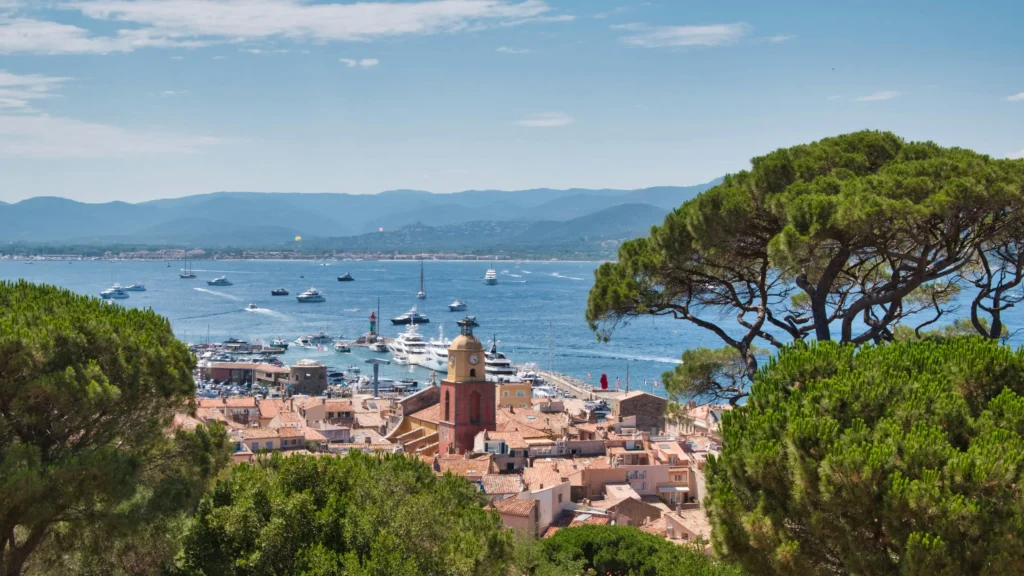
To conclude the visit in style, climb to the top of the hexagonal keep and the terraces of the ramparts. This exceptional viewpoint offers a spectacular 360-degree panoramic view over the entire Gulf of Saint-Tropez, the village’s ochre-tiled roofs dominated by the famous pink-and-yellow bell tower of the Church of Notre-Dame-de-l’Assomption, and the Mediterranean Sea stretching as far as the eye can see. In the background, the view extends over the Maures mountains and the copper-coloured Esterel massif.
How can one talk about Saint-Tropez without mentioning its former gendarmerie station, made famous by Louis de Funès? The Museum of the Gendarmerie and Cinema is housed in a building on Place Blanqui that served as the town’s gendarmerie station between 1879 and 2003. The idea of creating a museum emerged in 2012. The site finally opened its doors in 2016, covering an area of 800 square metres, including 600 square metres of exhibition space. It was created by Atelier des Charrons and designed as an immersive and interactive venue featuring period reconstructions.
Discover the world of the gendarmerie
The first floor of the Museum of the Gendarmerie and Cinema is divided into different areas. The first traces the history of the building and its development since the 19th century. The second offers a general introduction to cinema in Saint-Tropez and on the French Riviera. Fans of Louis de Funès will find what they are looking for in the third area, which is entirely dedicated to the famous Gendarme de Saint-Tropez series. Among other features, you will find a life-size bronze sculpture of Louis de Funès, perfect for taking souvenir photographs, as well as a reconstructed cinema room dedicated to the cult series. The final area provides an overview of the various professions involved in the seventh art.
Cinema in Saint-Tropez on the second floor
On reaching the second floor, the exhibition opens with a moving tribute to the close relationship between Saint-Tropez and the seventh art. The museum explores the transformation of the small fishing port into a global cinematic legend, a phenomenon initiated in 1956 by Roger Vadim’s cult film And God Created Woman. An entire room is dedicated to Brigitte Bardot, the true icon of the French Riviera who propelled the village onto the international stage. Beyond the Bardot phenomenon, the exhibition retraces the golden age of filming on the French Riviera, highlighting other masterpieces shot on the peninsula, such as Jacques Deray’s La Piscine (1969), starring Alain Delon and Romy Schneider. Scenes inspired by National Route 7, featuring vintage vehicles, can also be found there.
Enjoy temporary exhibitions
To enrich the permanent experience, the museum’s upper level and modular spaces host regularly renewed temporary exhibitions. These thematic displays explore the many facets of the region’s cultural, hospitality and artistic creativity. For example, from 1 February 2017 to 15 January 2018, an exhibition entitled “Brigitte Bardot: Myth in Saint-Tropez” explored the icon’s life in the town. From 1 June 2019 to 31 October 2020, visitors were able to discover “Johnny Hallyday in Saint-Tropez”. From 13 April 2024 to 9 March 2025, the 60th anniversary of the first Gendarme de Saint-Tropez film was celebrated through the exhibition “Attention!”
Also known as Place Carnot, Place des Lices is considered the beating heart and a symbol of the village’s art of living. Located near the port and the citadel, this iconic esplanade was laid out in the early 1800s as a rectangular pétanque court shaded by centuries-old plane trees. It is surrounded by an 18th-century central fountain and countless terraces where visitors can enjoy a drink or a good meal. According to legend, its name comes from the medieval tournaments and jousting events once held there.
Under the plane trees
The visit begins in the heart of the square, beneath its majestic centuries-old plane trees, planted in the 19th century around 1830. The name “Lices” refers to the areas outside the ramparts where jousting tournaments and military exercises once took place. This esplanade has managed to preserve its Provençal authenticity amid the lively atmosphere of Saint-Tropez.
The pétanque tradition
It is difficult to talk about Place des Lices without mentioning pétanque, a true local institution. Ask your driver-guide to drop you off directly near the central area to watch the games. Did you know that celebrities such as Brigitte Bardot and Johnny Hallyday have already played here? This gives you an idea of the legendary status of this pétanque court.
The Provençal market at Place des Lices
If your visit takes place on a Tuesday or Saturday morning, stop at the famous market on Place des Lices. An explosion of colours and aromas awaits you, with stalls selling textiles, antiques, spices, olives, lavender and local crafts, including the iconic Tropezienne sandals. Take the opportunity to admire the colourful façades and cafés lining the square during your stroll.
A stop at the historic cafés
Continue along the iconic terraces surrounding the square’s hard-packed earth:
Café des Arts: Open since 1891, this historic meeting place for locals and artists is known for its authentic and unpretentious atmosphere.
Café Saint-Tropez: An ideal spot for watching the elegant comings and goings while enjoying Provençal and Mediterranean cuisine inspired by brasserie dishes.
Hôtel Byblos: a glamorous legacy
End the tour at the foot of Avenue Paul Signac, just a short distance from the square, and turn your gaze towards Hôtel Byblos, inaugurated in 1967 by Brigitte Bardot and Gunter Sachs. This legendary establishment was designed as a small Mediterranean village made up of fountains and lush gardens. A refuge for numerous celebrities, including Mick Jagger and Bianca, who were married there in 1971, it embodies Saint-Tropez’s transition towards international luxury while drawing inspiration from the architecture of a Mediterranean village.
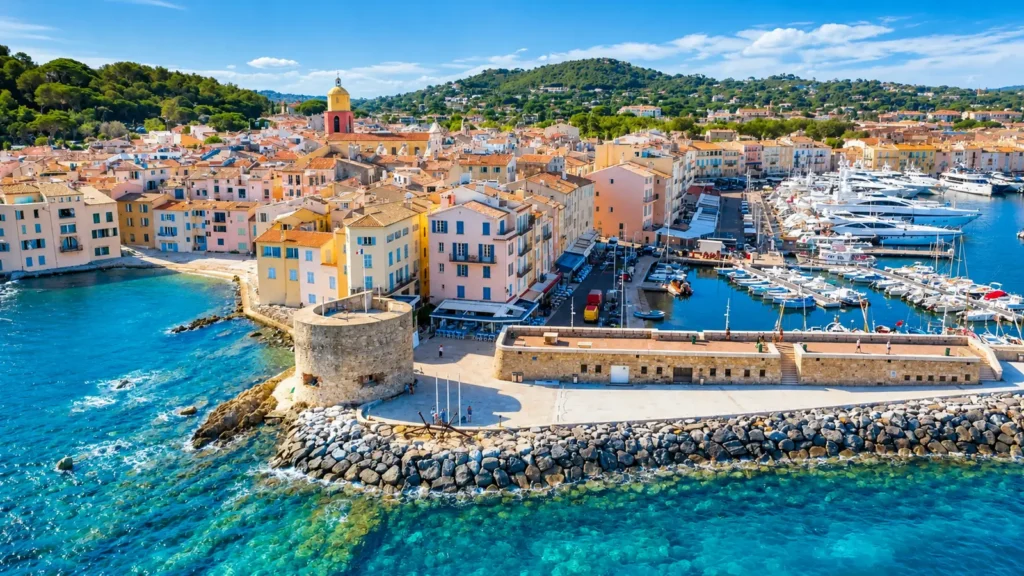
A fishing and pleasure port, the Old Port of Saint-Tropez is one of the town’s must-see tourist attractions. It was founded by the Phocaeans around 600 BC. During the Middle Ages, trade developed alongside fishing, with the export of local fish, wine, wood and cork. The Old Port was transformed into a summer marina for the yachts of the world’s wealthiest people following the international success of Roger Vadim’s film And God Created Woman, starring Brigitte Bardot and Jean-Louis Trintignant, released in 1956. It extends across two basins covering 9 hectares and has berthing capacity for 800 boats. All around it, boutiques, ice-cream shops, museums, cafés, restaurants, nightlife venues and street artists bring the area to life.
Admire the colourful façades and quays
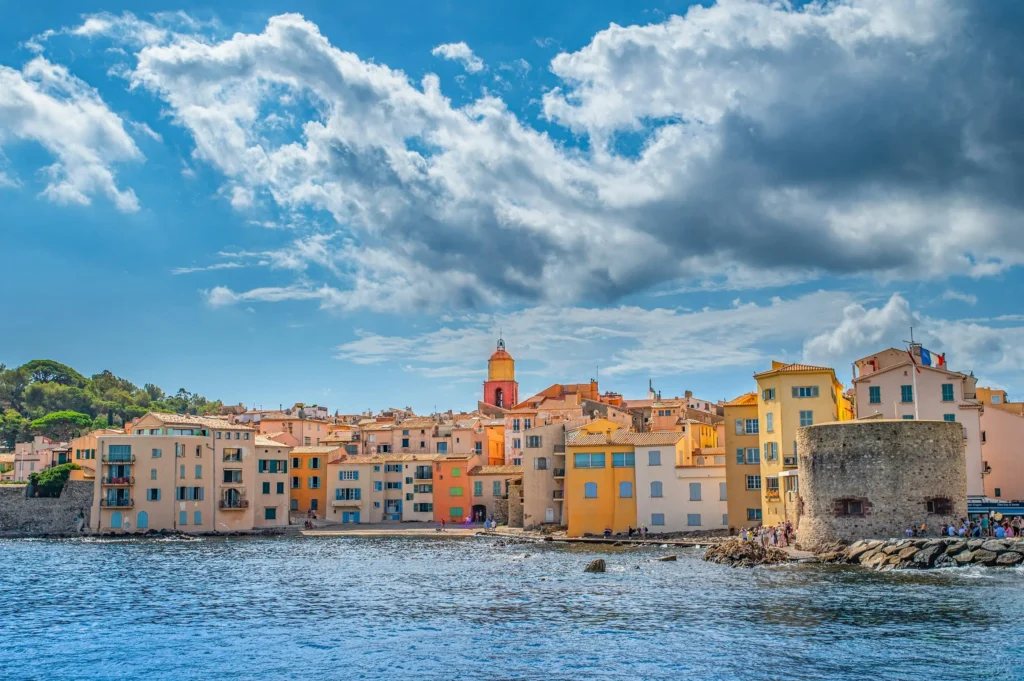
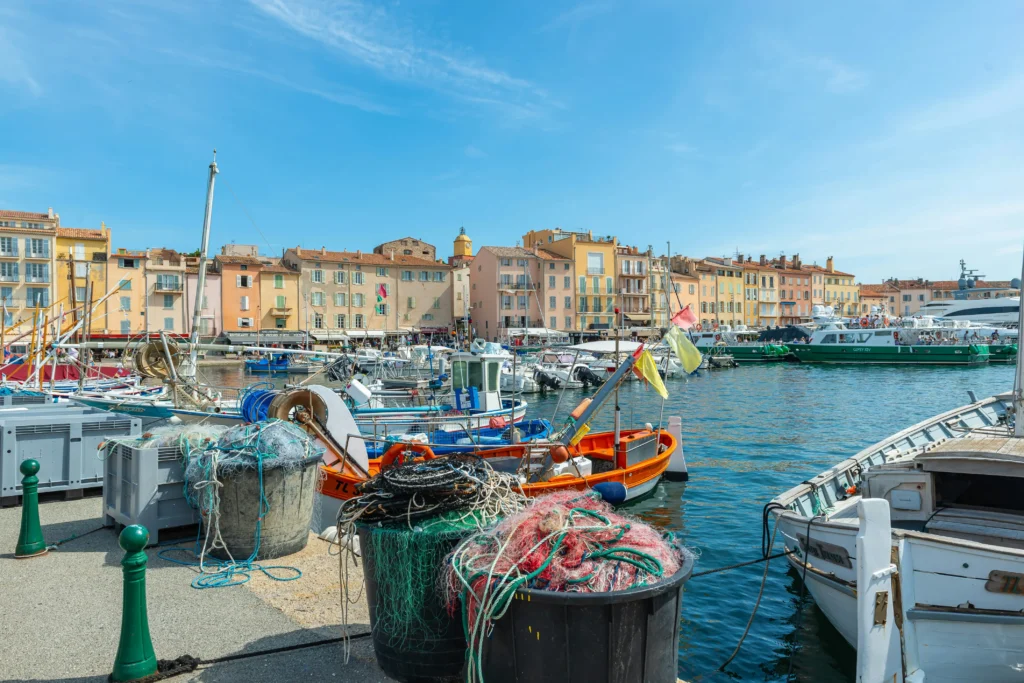
Begin your immersion on Quai Suffren and Quai Gabriel-Péri, where the Old Port reveals its most famous setting: a remarkable row of fishermen’s houses with narrow façades painted in warm shades of ochre, pink and pastel yellow. Stroll along the quay to observe the striking contrast between the traditional pointus—Provençal wooden boats—and the luxury yachts moored side by side. This is where the glamorous heart of the village beats, popularised in the 1950s by the French New Wave. Take the opportunity to admire the bronze statue of the Bailli de Suffren, inaugurated in 1866, and stop in front of the legendary red façade of Café Sénéquier, an institution founded in 1887 where artists and international personalities gather.
Môle Jean-Réveille: enjoy a panoramic view
Continue your walk towards the north-western end of the port along Môle Jean-Réveille, the large protective jetty built to shelter the basin from the sea swell. Walking along the lighthouse to the end of the structure, you will enjoy a spectacular, unobstructed view over the entire Gulf of Saint-Tropez, Canebiers Bay and the copper-coloured hills of the Esterel massif.
A gourmet break to taste the tarte tropézienne
No itinerary around the Old Port would be complete without celebrating the local culinary heritage. Take a break on the quays to enjoy the famous tarte tropézienne. Created in 1955 by Polish-born pastry chef Alexandre Micka in his bakery on Place de la Mairie, this iconic speciality consists of a soft brioche sprinkled with large grains of sugar and filled with a secret blend of two smooth creams. Legend has it that Brigitte Bardot herself, who was filming And God Created Woman at the time, was so charmed by the cake that she named it “Tarte de Saint-Tropez”.
Your driver will take you back to your hotel, your address or the requested drop-off location. The return journey brings the visit to a peaceful conclusion.
Included:
- Private vehicle(s) of your choice
- English- and French-speaking driver-guide with knowledge of the region; other languages available on request
- Four-hour half-day excursion
- Pick-up at your address
- Drop-off
- Fuel and tolls
- Free cancellation up to 24 hours before departure
Not included:
- Admission to the Museum of Maritime History: approximately €5
- Admission to the Museum of the Gendarmerie and Cinema: approximately €5
- Meals
- Tips, at your discretion
- Specialist guide, available on request only
Choose your vehicle
Premium vehicles for optimal comfort.

Mercedes E-Class
Premium Class
Mercedes VAN 8 pax
Premium Class
Mercedes V-Class
Premium Class
Mercedess S-Class
Premium Class
Mercedes Sprinter
Premium Class
Mercedes VIP Sprinter VAN
Premium ClassConfigure your trip
Please enter your trip details below.
Select a vehicle to see the price.